Get RNS’ thoughtful, essential religion reporting every morning. Sign up for free!
(RNS) — Less than two months after the death of televangelist Jim Bakker, Netflix released a documentary about his rise and ruin as well as his feud with another religious broadcaster, Jimmy Swaggart, also embroiled in scandal.
“Primetime Preacher$,” released last week, primarily tells the story of Jim Bakker through archival recordings of him and his wife Tammy Faye Bakker as they co-hosted the flagship TV show of their Praise the Lord ministry and discussed their lives in interviews. It features extensive interviews with journalists, scholars and insiders who provided security and solicited donations for the ministry and its Heritage USA theme park in South Carolina that once attracted 6 million visitors a year. A pioneer in Christian broadcasting for their show, “The PTL Club,” Jim Bakker admitted to a sexual encounter with a church secretary and was convicted of financial crimes and spent five years in prison.
Bakker died Oct. 5 and was predeceased by his wife, who divorced him and became Tammy Faye Messner. Jerry Falwell and Swaggart, two other titans in televangelism featured in the documentary, died in 2007 and 2025, respectively.
Here are six takeaways from the documentary:
In the midst of a federal government investigation into PTL fundraising, Jim Bakker welcomed Ronald Reagan, then-presidential candidate.
Reagan, running for president in 1979, was a guest on “The PTL Club” when the preacher asked Reagan what he would do to stop government encroachment into the church.
RELATED: Televangelist Jim Bakker, once imprisoned for scandal, dies at 86
“If elected president, would you do something to stop this control of American life, and could you?” asked Jim Bakker as his ministry was the subject of an investigation by the Federal Communications Commission.
Reagan nodded. “I sure would and I think it can be done.”

Calling the 1980 election the nation’s most important, Jim Bakker used his platform to rally Christian voters: “I believe we can deliver, with God’s help, 50 million votes. I believe that with all my heart.”
Reagan, who went on to win by a landslide, accepted the prediction, noting that without a win, their generation might be the one to experience Armageddon, a final battle between good and evil.
The Bakkers knew how to use broadcast media for their own purposes.
When the PTL ministry launched its satellite television network in 1978, it embraced the technology before ABC, CBS and NBC were using it widely.
“From this moment on, The PTL Television Network plans to broadcast television nonstop 24 hours a day until the second coming of Jesus Christ,” Jim Bakker proclaimed.

Later, when The Charlotte Observer prepared to reveal the Bakkers had bought a pricey home in Palm Desert, California, the couple preemptively aired a promotional video presentation of their home, showing off its bedrooms and luxury purchases.
“It was the lives of the rich and famous done on Christian television,” said John Wigger, author of “PTL: The Rise and Fall of Jim and Tammy Bakker’s Evangelical Empire,” and one of the key voices in the film.
The church secretary was widely derided at the time, but the documentary portrays her as a sex abuse victim.
A 1987 investigation by The Charlotte Observer revealed that Jessica Hahn, a church secretary, was paid off with ministry funds to keep silent about a sexual encounter with Jim Bakker. That revelation forced him to resign as head of the PTL ministry.
The documentary describes her as the victim of a sexual assault, a claim Jim Bakker long denied.
“Hahn was generally treated like an opportunistic woman who had taken advantage of a successful, vulnerable older man,” said Wigger, who said he believes the encounter was an assault and not an affair.
Footage includes a Saturday Night Live “Church Chat” skit where actress Jan Hooks, playing Hahn, said, “I am not a whore,” and Dana Carvey’s Church Lady replied, “And I am not the church lady.” On shows from “Donahue” to “CNN Crossfire,” interviewers asked Hahn how she squared her conscience with taking settlement money and how she could be angry at Jim Bakker.
In an interview on “Larry King Live,” Hahn said she received about $30,000 before the $265,000 settlement she signed with Jim Bakker fell apart. She later was paid $1 million for topless images and an article in Playboy magazine.
Hahn told King that she didn’t expect to live down her reputation as a “cartoon character” and “a bimbo” that “brought down an empire.” She added she “never once” questioned her belief in God.
“I believe in God because he’s the only thing that kept me going,” she said.
The friend Jim Bakker called for help eventually shut him out.
The blaming of Hahn was only the beginning of the scandals that would engulf Jim Bakker and his ministry.
“I’ve asked my friend Jerry Falwell to help me in my crisis,” Jim Bakker announced early on, expecting he’d be able to return to his ministry.
When Falwell, a televangelist and the leader of the Moral Majority, and his team began looking into PTL’s finances, he discovered the Bakkers’ received almost $5 million in compensation between 1984 and 1987 and misused ministry funds. He determined Jim Bakker should never return to that ministry.

At a news conference, he held up Tammy Faye Bakker’s stationery with a handwritten list of severance requests, which included lifetime salaries of $300,000 annually for Jim Bakker and $100,000 annually for his wife.
“I don’t see any concern for the welfare of this ministry in that kind of a request,” Falwell said. “I see the avarice that brought them down.”
Then, Swaggart, a rival Louisiana televangelist, admitted he urged church leaders to investigate allegations about the sexual encounter with Hahn.
“There’s a smellier laundry in (Swaggart’s) hamper than the laundry that he thought was in Rev. Bakker’s,” attorney Norman Roy Grutman, Jim Bakker’s attorney, said.

Within a year of Jim Bakker’s downfall, Swaggart himself was investigated and was photographed visiting a prostitute in New Orleans. In the documentary, Scott Bailey, a private investigator, described the discovery. “He had a hole cut in the bottom of his jogging suit so he wouldn’t have to take his clothes off,” said Bailey, “in case he needed to make a quick escape or somebody came in, he wouldn’t be disrobed.”
Tammy Faye was embraced by the gay community.
Tammy Faye Bakker was often reduced to a caricature of a woman with heavy makeup, but the documentary presents a fuller portrait: a public figure who privately wrestled with addiction to prescription medicines and suffered from loneliness as her then-husband Jim Bakker focused on building Heritage USA.
She also became an icon in the gay community, a status that outlasted her marriage to Jim Bakker and followed during her marriage to Roe Messner, who was responsible for much of the construction of Heritage USA. In 1985, she interviewed a man with AIDS via video link when he was too ill to come to the PTL studio. Years later, in 1996, she appeared on“The RuPaul Show.”
“Everybody must be who they are,” she said on that episode of RuPaul’s show. “Young people, don’t ever let anyone make you something you are not. You have the right to be who you are.”

Said Wigger in the documentary: “She is the one person out of this story that people still love. Tammy Faye was a survivor.”
To the end, Tammy Faye Bakker also held onto her faith, including when she was ill with inoperable cancer.
King asked her in an interview on the day before her death about where she would be when she left the earth.
“I believe when I leave this earth, because I love the Lord, I’m going straight to heaven,” she declared with a smile.
A former insider still regrets what might have been.
Over the course of the film, Don Hardister, Jim Bakker’s former security guard, described how hopes for the Heritage USA theme park rose and then collapsed.
“We were determined to knock Walt Disney off the stump,” he recalled. “We wanted to be the number one theme park in America. That was our goal.”
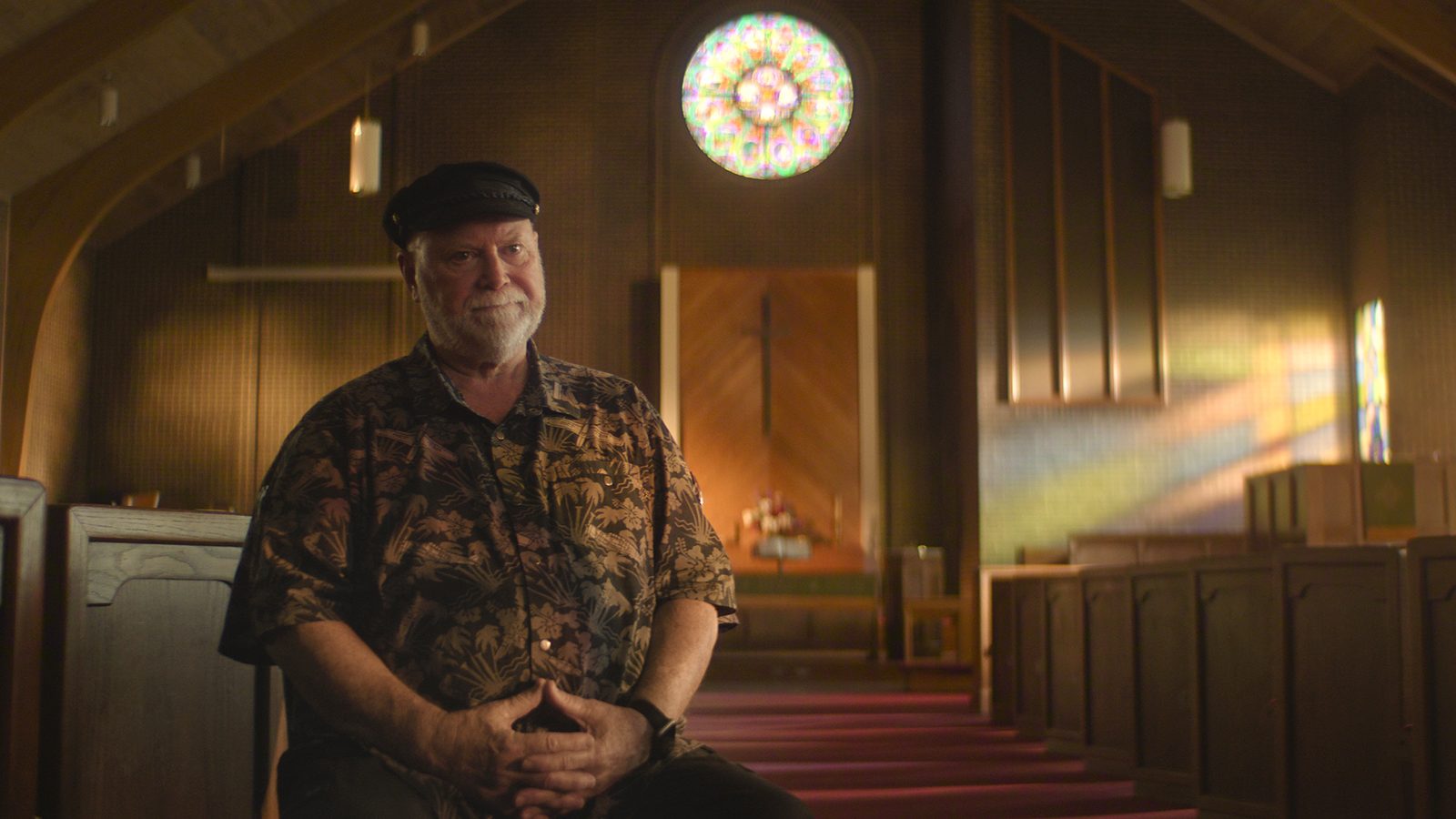
But once the financial and sex scandals became public, the ministry was perpetually in debt.
“If we were a million behind, I think we were pretty happy we were just a million behind,” he recalled.
At the end of the film, Hardister tearfully described Jim Bakker’s emotional collapse during the trial that sent him to prison for five years.
“I wake up every morning and my first thought is we blew it,” he said. “We had the opportunity of opportunities to reach the entire globe to spread the gospel. We had a satellite network and we blew it. And I’m sorry about that.”
RELATED: How Jim Bakker became the Johnny Carson of Christian TV