(REVIEW) We’re starting to see the rise of a new kind of film in the faith-based market: the faith-based action genre. From Amazon’s “House of David” and the Daily Wire’s “Pendragon Cycle” to this year’s “Young Washington” and Angel Studios’ faith-friendly PG-13 action film “Runner,” a market that used to be dominated almost exclusively by inspirational melodramas is now showcasing a lot of dudes fighting bad guys with swords and guns.
This should come as no surprise. While Christian life in America has historically been dominated by married women, the gender gap is shifting, with more Gen Z men than women attending church. Likewise, liberals have been leaving Christianity at a much higher rate than conservatives.
At the same time, men are more likely than women to be conservatives — particularly married men — and conservatives are developing warmer feelings toward faith, even if they aren't religious. Meanwhile, religious people and conservatives are increasingly the ones having families. This means the tide is turning in favor of “red-state” movies that appeal to a coalition of conservative Christians, men — particularly dads — families and faith-friendly conservatives.

Give now through Dec. 31 and your donation will be matched by NewsMatch. Thank you!
“Ghost Soldier” seems engineered in a lab to appeal to this very audience. But sadly, the film is more a parade of clichés than an enjoyable action romp. That means that while the audience may be there, the filmmakers aren't quite ready to meet it.
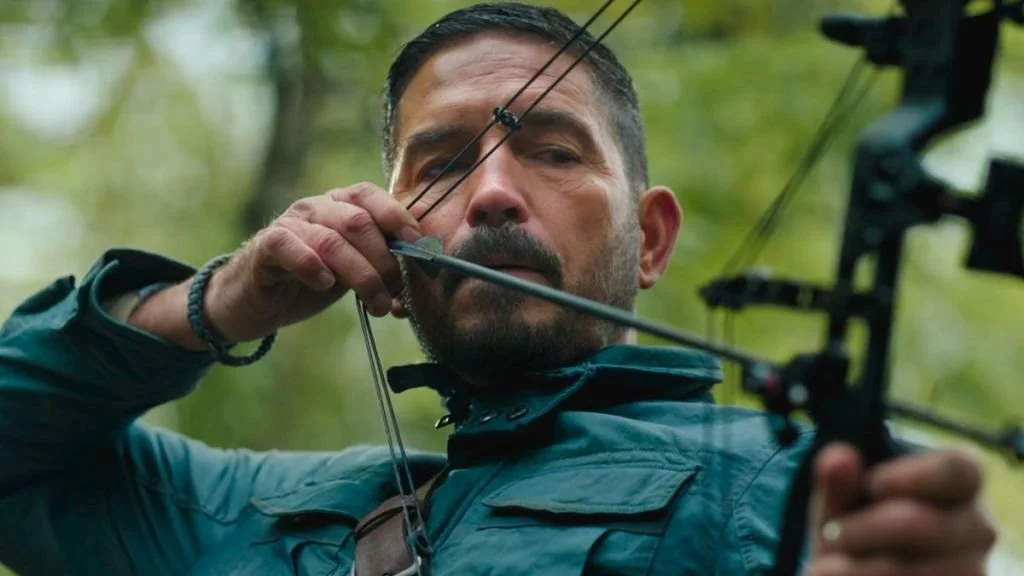
In this action thriller, Jim Caviezel stars as Henry “Fitz” Fitzgerald, a solitary man with a mysterious past who lives a quiet life off the grid in his hometown. But when a powerful foreign corporation descends on his community, determined to seize his and his neighbors’ land for a massive payday, Fitz takes action. He's actually a former Special Forces soldier and advanced weapons developer. Armed with weapons no one has ever seen, a lifetime of lethal military training and an unwavering code of justice, Fitz becomes the one thing his enemies never anticipated: a one-man war they can't win.
Like old-school faith-based melodramas, “Ghost Soldier” seems like a sincere effort by most of those involved. Writer Chris Papasadero is a former Green Beret who wanted to write the film because he was “seeing the convergence of corporate and government power and wanting to write a story in which a hero can fight back against that convergence.”
Caviezel is similarly an outspoken conservative Catholic (going so far as to promote QAnon conspiracy theories during his “Sound of Freedom” film promotion) who sees Hollywood as hostile to Christian values and wants Christian content to be better than anything Hollywood produces. “Faith-based films is not a compliment. I believe that we should be able to make films that are better than all of their films because we have the truth,” he has said. Producer David Zelon described the film as “a very pro-military, pro-America kind of movie.” Director William Eubank — whose little brother is in the military — describes his politics as “middle of the road” but says the script reminded him of the movies he “loved growing up.”
You see most of the elements you'd want in a character like Fitz and the characters and action surrounding him. Fitz is the classic ex-Army cool killer with a heart of gold who just wants to be left alone and “works with the system but not for the system” until bad guys (in this case, greedy corporations) try to hurt his friends and he springs into action. The film is populated by sympathetic friends and bystanders for Fitz to care about, fight alongside and protect, as well as suitably dastardly bad guys for him to kill.
What makes “Ghost Soldier” particularly interesting is how well it reflects a particular evolving red-state identity without being explicitly partisan or automatically off-putting to blue-state viewers. Conservative Christians have long felt unrepresented in Hollywood — something Caviezel himself has remarked on — and this film attempts to address that. The movie’s protagonist is explicitly Christian. He prays, asks the Archangel Michael to protect him and includes references to God in his action-hero one-liners. (“God will judge our enemies; I’ll just arrange the meeting.”).
The boy Fitz is protecting, Jack, has a father who died as a soldier. Jack’s family proudly displays an American flag in their home and prays before dinner with Fitz. The bad guys are all villains of the conservative imagination: evil corporations teamed up with corrupt politicians in the pockets of foreign billionaires, messing with American land and sending foreign thugs to kill innocent people.
Typically, we have movies about Christians that promote peace over violence (e.g., “Drummer Boy” and “Wake Up Dead Man”) or action heroes who stand by the flag while fighting enemies foreign and domestic (e.g., “Transformers” and “The Covenant”). Yet Christian, patriotic and military communities consistently overlap. Christians are increasingly more likely to be conservatives, and conservatives are more likely to be patriotic. The military is increasingly made up of Christians. “Ghost Soldier,” wherever you stand ideologically, is an example of these beliefs and communities being reflected onscreen.
The film also finds ways to avoid being overtly partisan. Anger at evil corporations and corrupt politicians in general is increasingly a bipartisan feeling. (Fitz even says, “Corporate tyranny is still tyranny,” for any conservatives who might be uncomfortable with the “evil corporation” cliché popping up again.) Fitz's family, whom he's fighting for, is Hispanic.
If it sounds like this film might be so focused on checking boxes that it forgets to actually develop any of its characters, themes or action, you'd be right. Like Caviezel's other action film, “Sound of Freedom,” ideology trumps quality. None of the characters move beyond two-dimensional archetypes. The action is boring and paint-by-numbers. All the dialogue consists of exposition dumps.
Take the relationship between Fitz and Jack. Theirs is the relationship that gets the most screen time. We watch Fitz teach Jack to hunt and become a kind of surrogate father to him. But halfway through, the boy exits the film so Fitz can go hunting with the sheriff, who hasn't been particularly important up to that point. So while the movie checks the box for “representation” of sons and father figures, it doesn't take that relationship anywhere important to the story or give it an emotional payoff.
One might suggest I'm asking too much from something that's just trying to be an action flick you can turn your brain off for. But I think that does a disservice to the legacy of action films. Look at any classic action movie. “Dirty Harry” has lots of action, yes. But it also has a slow, steady, somber current of despair over heroes who have lost their will to fight back against the bad guys. “Death Wish” focuses on the hero's despair and his slow acceptance of violent revenge as a response to it. “Die Hard” focuses on repairing the relationship between a husband and wife. “Taken” is primarily about a father and daughter repairing their relationship.
Even if you're just here for the action, you'll be disappointed. The portrayal of Fitz undermines most of the tension in the fight scenes. “Die Hard” establishes McClane as an ordinary guy going up against real professionals. So we hold our breath wondering how he'll get out of each situation. “John Wick” establishes Wick as a powerhouse but also gives us a basic idea of his limits. So we can be impressed as we watch him overcome them with creativity or sheer willpower.
But Fitz basically has any gadget he needs at any given time to get out of any situation. So there's no tension in the fight scenes. Even Batman and Iron Man typically establish what gadgets they have at the beginning or middle of a film, so when they fight the villain, we can see that the villain is still a threat given what's been established. And when they do use their gadgets, the weapons are actually, well, cool, and not something we've seen a hundred times before. (Oh, my gosh! A cloak that makes you ... invisible? I've never seen that before!).
There is one genuinely interesting relationship that the whole movie could have been built around if it had lasted beyond one scene. It's between Fitz and his military agency contact and friend, Scott Peary (played by Shea Whigham). Scott tries to convince Fitz to step away from his crusade against the film's corporation. Fitz pulls a gun on Scott and accuses him of being sent to deal with him. Scott calmly walks toward Fitz — daring him to shoot — and when Fitz doesn't fire, Scott gently pushes the gun away. They establish a deal: Fitz says he'll fight Scott's wars if Scott lets him fight this battle.
What you have in this one scene are real characters with complexity beyond their archetypes. Fitz is brilliant and heroic, but he's also paranoid and antisocial. Scott is a bureaucrat, yes, but he's neither incompetent nor corrupt. This is a relationship you could build a franchise on, like “Lethal Weapon.” For a moment, Fitz actually fulfills the promise of a character who's a cross between Shane and Batman. If the film had made this relationship more central or infused its other relationships with similar depth, it would have been a lot better and certainly a lot more fun.
“Ghost Soldier” has all the ingredients to make a fun action film that reflects a rare cross-section of the values and experiences of Christian viewers. But ingredients don't matter if you don't have a cook capable of mixing them properly. Traditional faith-based films took 20 years before they started getting good. Hopefully, this genre won't have to wait that long.
“Ghost Soldier” is playing now in theaters.
Joseph Holmes is an award-nominated filmmaker and culture critic living in New York. He is co-host of the podcast “The Overthinkers” and its companion website theoverthinkersjournal.world, where he discusses art, culture and faith with his fellow overthinkers. His other work and contact info can be found at josephholmesstudios.com.